


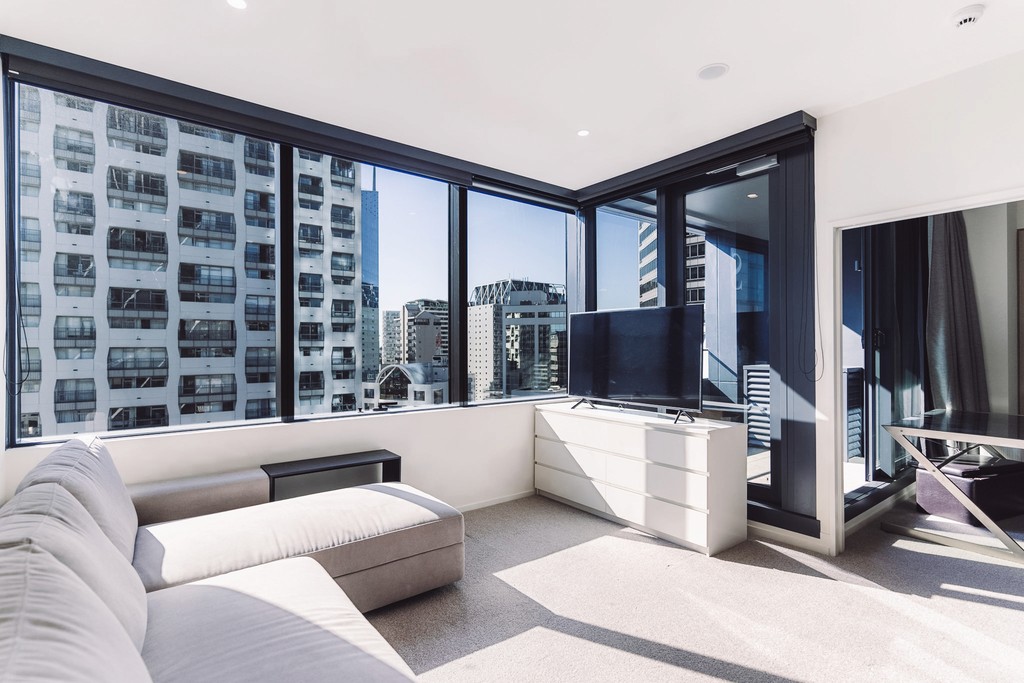


GENERAL SYSTEM ARRANGEMENT
A structurally glazed unitised curtainwall system based on a nominal 164mm x 80mm mullion. It features interlocking male/female mullions and gutter stack transoms.
Panels are typically fixed to the structure via brackets at the top mullion, creating a deadload condition. The stack joint, positioned at or above slab level, receives the panel from the floor above, transferring lateral and wind loads into the gutter.
Integrated movement joints ensure an airtight, weathertight envelope while accommodating structural tolerances, thermal expansion, and seismic movement.
SPANS AND CAPACITY
Span Capacity varies project by project based on a number of interrelated variables, but a typical panel size in the 180 Unitised System is circa 3200mmH x 1400mmW. The System can be used in demanding wind zones up to 3.6kPa ULS and with a Seismic Interfloor Drift ULS 60mm
FRAME TYPES & FEATURES
Whilst a Curtain Wall does not have a “frame” as such, there are different Seismic Heads, Jambs and Cills that give different aesthetic outcomes at structural interfaces. Typical Seismic Head and Jambs may be the 180101 Frame with a 180102 Bead which gives a typical deflection channel and bead condition
The 180103 Frame is more suited to a situation where the interface with structure or other materials needs to look seamless and the 24mm expressed gap between mullions is to continue.
Similarly there are options for the Seismic Cill. A traditional Cill Tray may be suitable where the system sits at floor level and requires a facing over an external cladding. Alternatively a stack join transom (180212) may be used at the cill with the option of the panel being dead loaded into the cill – or the cill accommodating lateral load only from a panel hung from structure above.
INSERTS, SASHES, FINS & FEATURES
The system has the capacity to accommodate a variety of infill products, including; Top Hung Sashes, Sliding Sashes (with Glazed Juliette Balustrades) and Insert Doors (open in and out). In additional to this, brackets off mullions (or transoms) can support external feature fins, shading devices, and well as signage, and feature panels external to the curtain wall.
Sizes and configurations vary with local wind pressures and site conditions.
INFILLS & GLAZING CAPACITY
The 180 UCW glazing cavity can be adapted with beads to suit a wide range of glass thicknesses, meeting diverse glazing requirements. A variety of infill materials can be used, including (but not limited to) glass, aluminium panels, composite panels, solid stone, GRC, terracotta tiles, and bricks.
Mullions and transoms can either feature a structural sealant finish—keeping the sealant and infill on the same external line—or expressed beads to highlight panel perimeters.
PERFORMANCE
The 180 UCW base system has been tested to withstand a wind pressure (ULS) of 3.6kPa and an ultimate limit state (ULS) interfloor drift of 60mm, with overall curtain wall performance varying based on factors such as panel size, mullion centres, structural connection type and positioning, and infill types—including doors, sashes, and sliding panels.
FINISHES & COLOURS
The System can be Surface Finished in a variety of options.
• Powdercoat to AAMA2604 in Standard Dulux, Akzo Nobel or Custom Colours
• PVDF Finish to AAMA2605
• Anodised 20 Micron
• Electrophoresis Anodised Finish
PERFORMANCE TESTING
KFI Curtain Wall Systems are generally Tested at an ILAC Accredited International Testing Facility to the Requirements of AS/NZS 4284
A library of Tests are kept for each system type, and if a project performance requirement exceeds or differs significantly from test reports on file, a project specific test can be carried out.
INSTALLATION
Installation is typically carried out by KFI as a part of the façade contract in order to give effect to warranties and producer statements.
MAINTENANCE
At the completion of a project KFI will compile and hand over a set of Completion Documents which includes a written Operation and Maintenance Manual – specifying the required cleaning, maintenance and inspection regime for various parts of the façade for the duration of the warranty period.
NZBC COMPLIANCE
A Compliance Pathway Report is created for each project, listing compliance with the following mandatory provisions of the New Zealand Building Code
B1 – Structure
B2 – Durability
E2 – External Moisture
F2 – Hazardous Building Materials
F4 – Safety from Falling
In addition to this KFI provides information on the Curtain Wall System to enable the satisfaction of
C3 – Fire affecting Areas Beyond the Source
G4 – Ventilation
G6 – Airborne and Impact Sound
G7 – Natural Light
H1 – Energy Efficiency